

TL;DR
The court recognized serious problems with how Kings County handled Avenal’s recall process: the City Clerk was the lawful official, there was no formal delegation giving the County the recall job, and the wrong official processed the petitions.
But the election survives anyway.
So the public is left with a remarkable new standard:
The rules matter right up until breaking them produces a result somebody wants to preserve.
Or, in plain Avenal English:
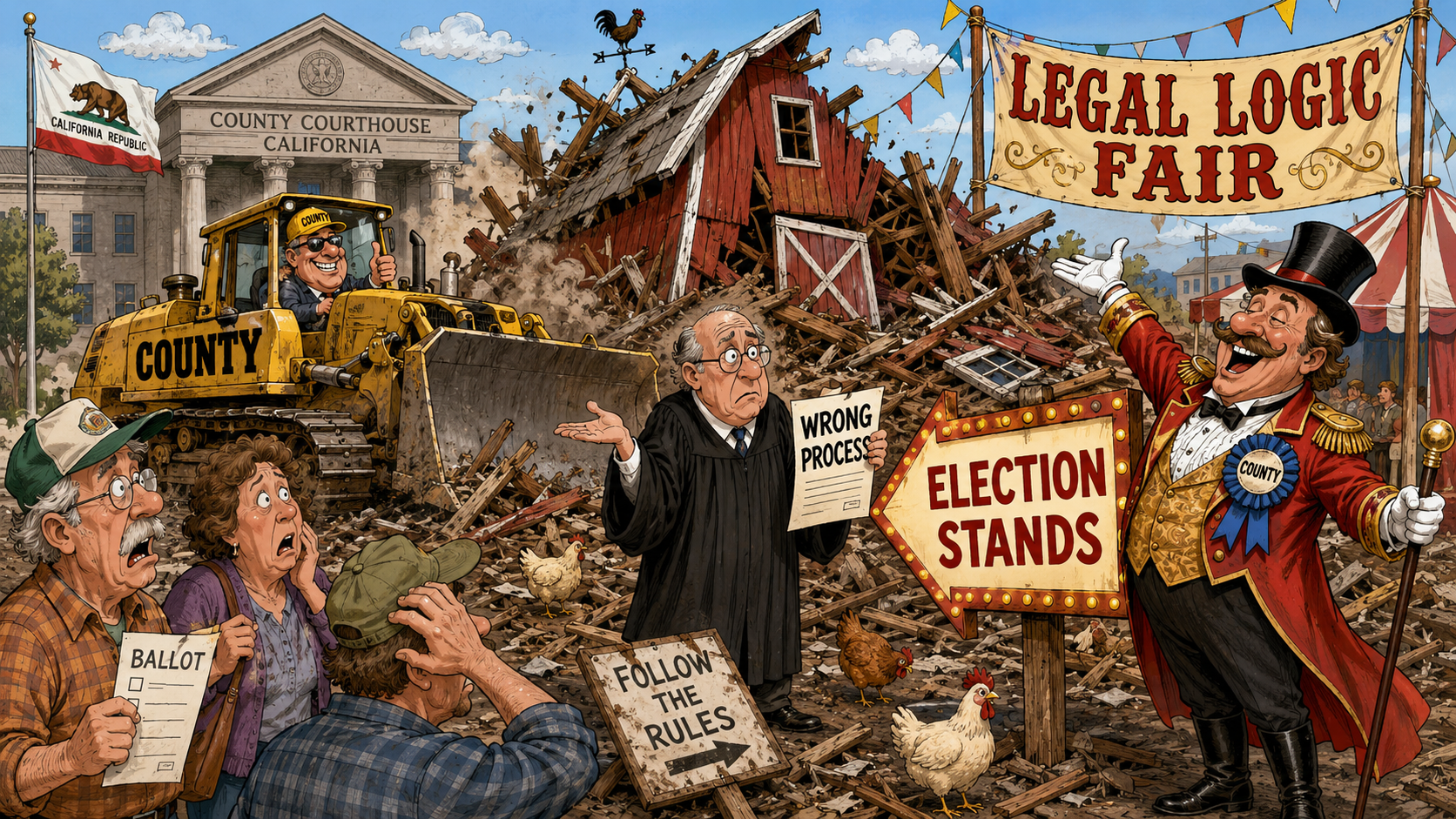
The County wasn’t supposed to knock down the barn. The judge agreed. But the barn is gone, so apparently everybody should admire the new view. 🐄⚖️
A guest editorial from the Department of “Wait, What?”
There are court rulings that make you think deeply about constitutional law.
There are court rulings that make you reconsider the delicate balance between procedure and democracy.
And then there are court rulings that make you stare at the page like your uncle just explained that the fence is technically on your property, but since his cow already ate your tomatoes, everybody should just move on.
Welcome to Avenal.
The basic problem with this ruling is not that the court cared about the voters.
Of course the voters matter.
The problem is that the court appears to say, in effect:
Yes, the process was handled by the wrong official. Yes, the City had not actually delegated that authority to the County. Yes, the County proceeded without the formal authorization that should have existed. But because the election happened and people voted, the result survives anyway.
The ruling materials are remarkably clear on the awkward part. The City Clerk was the lawful elections official. There was no formal resolution delegating recall authority to Kings County. Nobody from the City affirmatively handed the recall process over to the County. And the wrong official processed the petitions.
Then comes the legal equivalent of:
“But other than that, Mrs. Lincoln, how was the election?”
The Will of the Voters Apparently Starts After the Mistake
The justification seems to rest heavily on protecting the will of the voters.
That sounds noble.
It also raises one tiny, annoying question:
Which voters?
Because there were also voters who believed the process itself mattered.
There were voters who expected the election laws to be followed before their elected officials could be removed.
There were voters who believed that when the law assigns responsibility to a particular local official, another agency cannot simply step in because it feels administratively convenient.
Those voters had a stake in the process too.
Their “will” was not merely expressed by marking a box on Election Day.
Their will was also expressed through the expectation that the election would be lawfully called, lawfully administered, and lawfully authorized.
If the process protects democracy only after the ballots are printed, then the rules leading up to the ballots apparently exist mainly as decorative parsley.
The Barn Wasn’t Yours, But You Already Knocked It Down
Here is the folksy version.
Suppose your neighbor decides your barn is ugly.
He does not own the barn.
You never gave him permission to touch the barn.
He is not the person legally responsible for deciding whether your barn stays or goes.
Nevertheless, one morning he shows up with a bulldozer and knocks it down.
You go to court.
The judge reviews everything and says:
“Well, you’re right. Your neighbor was not actually authorized to demolish your barn.”
Excellent.
Then the judge looks out the window at the pile of lumber and says:
“But the barn is already gone, so we’re going to honor the demolition.”
That is the part where most normal human beings stop nodding politely.
Because at some point, a rule that can be violated without consequence is not much of a rule.
It is a suggestion wearing a necktie.
Procedure Is Apparently Very Important Until Government Misses One
Ordinary citizens are told constantly that procedures matter.
Miss the deadline? Denied.
Forget a signature? Rejected.
File with the wrong office? Try again.
Forget to get approval before starting construction? Stop work.
Use the wrong form? Sorry.
Government loves procedure so much that there is usually a procedure for requesting the procedure manual.
But when government itself uses the wrong official for an election process?
Suddenly everyone discovers their inner philosopher.
“What is authority, really?”
“Is authorization merely a social construct?”
“Did the election not become legitimate through the collective spiritual energy of the ballots?”
No.
Either the law required the City to delegate that authority or it did not.
Either the County had the authority when it acted or it did not.
The court itself recognized that no legal authority expressly vested the County with the power to call the election, yet concluded that the County could proceed under the circumstances.
That may have a legal rationale.
It is still astonishingly difficult to explain over coffee without sounding like you are making it up.
“The Voters Have Spoken” Is Not a Universal Magic Spell
There is another uncomfortable problem with the reasoning.
Saying “the voters have spoken” cannot automatically cure every defect.
Otherwise, why have election law?
Imagine applying this theory everywhere.
“Sure, the polling place opened three days early, but people voted.”
“Yes, the wrong agency conducted the election, but people voted.”
“True, nobody had authority to put the question on the ballot, but have you considered that people voted?”
At some point “the will of the voters” stops being a democratic principle and becomes a magic phrase used to make procedural violations disappear.
The better democratic principle is simpler:
The voters deserve both a meaningful vote and a lawful election.
Those ideas are not enemies.
They are supposed to work together.
So Who Exactly Got Justice?
The people who supported the recall can understandably say their votes were preserved.
Fair enough.
But people who challenged the legality of the process can also reasonably ask what remedy exists when a court effectively agrees that the government did not follow the proper chain of authority and then leaves the result untouched.
Because there is a fundamental difference between:
“You were wrong about the process.”
and
“You were right about the process, but it changes nothing.”
The second one is a particularly strange form of victory.
It is like winning your small-claims case and receiving a certificate that says:
CONGRATULATIONS: YOU WERE CORRECT. NO REFUNDS.
The court materials ultimately describe the procedural problems as insufficient to overcome the election result.
For people who believed the process was unlawful, that can reasonably feel less like justice and more like receiving a very detailed explanation of why being right does not matter.
Welcome to the New Election Rule
So, as best we can tell, the new civic lesson is:
- There is a legally designated election official.
- Another government agency handles the process instead.
- The required formal delegation does not exist.
- The election proceeds.
- A court later recognizes the problem.
- The result survives because undoing it would interfere with the voters.
Which leaves us with the uncomfortable question:
If the result of violating the procedure is identical to following the procedure, what incentive does government have to follow it next time?
That is not a partisan question.
That is not a recall question.
That is a basic rule-of-law question.
Because someday the people celebrating this result may find themselves on the other side of a government shortcut.
And when they object, they may discover that the answer has already been written:
Yes, they did it wrong. But they already did it.
Satire and commentary about a public court ruling, public agencies, and election procedure. The jokes are exaggerated. The procedural contradiction is doing most of the work by itself.